
Put it in writing.
Because sometimes having a verbal agreement doesn't always work out well, especially for you young folks.

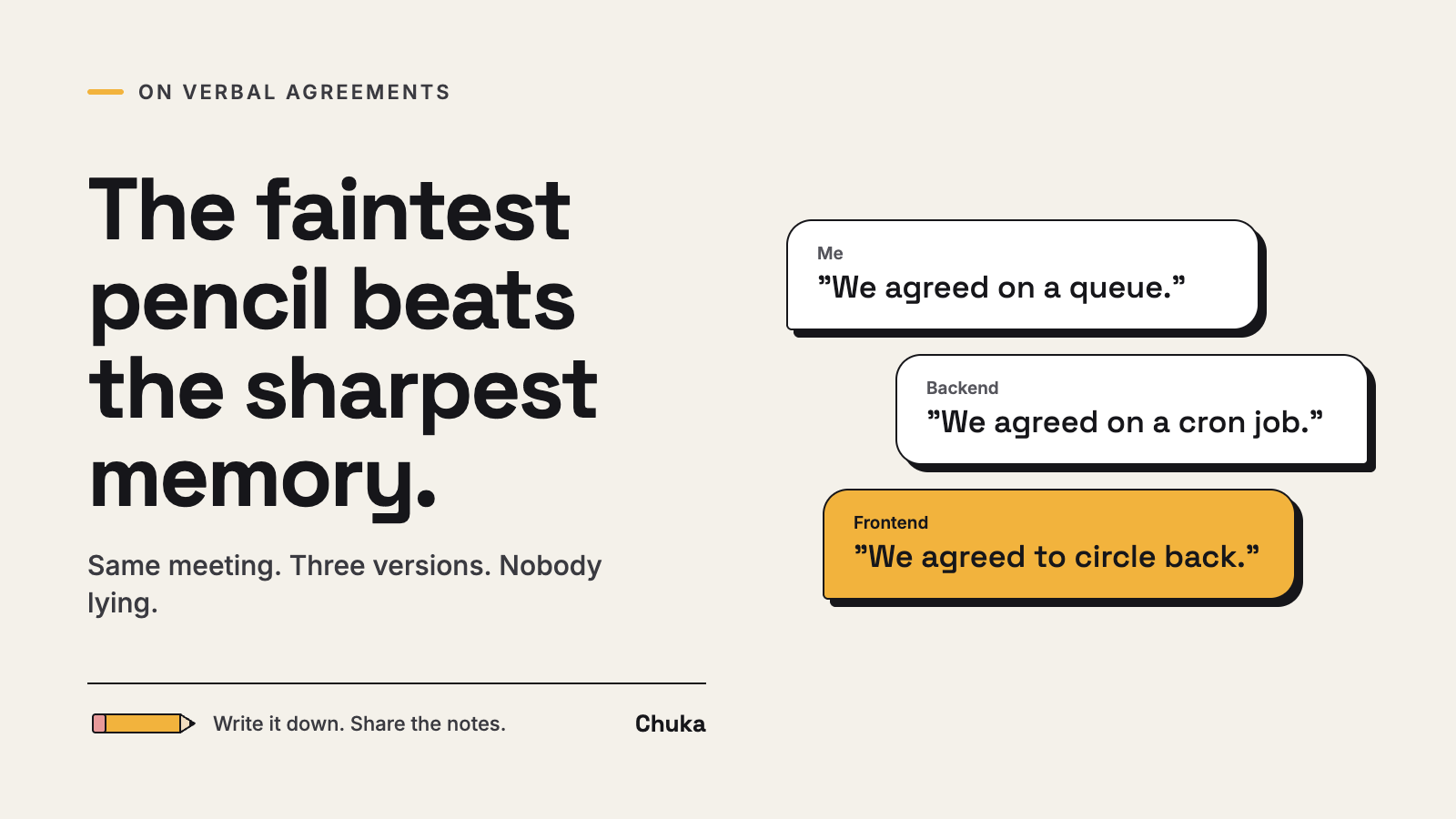
Verbal agreements are risky.
They feel friendly in the moment. Then memory fades, and each person remembers the agreement a little differently. Nobody has to be lying. Three months later, though, everyone is confidently quoting a meeting that apparently happened in three parallel universes. 😅
It has happened to me more than once.
This has happened to me more times than I'd like to admit, usually when agreeing on a technical execution path. We'd leave a call aligned on the approach. Everyone nodding, everyone happy. Nobody wrote it down, and boom. What got built was not what we agreed. Not because anyone went rogue. Everyone walked away with their own version of the plan, and each of them built that version faithfully. One person heard "we'll use a queue". Another heard "we'll start with a cron job and revisit". A third heard "let's circle back on this". All three were in the same meeting.
By the time the difference shows up, it shows up as rework.
The Affair problem.
It reminds me of the TV series The Affair (I enjoyed this one). The same events are told from different perspectives, and each version feels completely true to the person telling it.
Engineering decisions work the same way, just with fewer dramatic beach scenes. Each person's memory of a meeting is shaped by what they cared about going in, what they were worried about, and what they had to do next. That isn't dishonesty. It's just how memory works.
Where the gaps hide.
An unwritten agreement is where ownership gaps hide. Who is doing what? What exactly did we decide? What did we explicitly decide not to do?
Those gaps cost more than most people expect: rework, missed handoffs, quiet resentment.
What I'm doing about it.
I'm trying to document more now. Not as bureaucracy, but to force alignment while everyone is still in the room. Shared AI meeting notes help a lot with this. Everyone sees the same summary, and if something is wrong, it gets corrected while the conversation is still fresh, not three months later in a code review.
And Lord knows how many times a simple email thread has saved me, just because it documents itself, with proof. Short written note, ticket whatever you use will suffice. It takes a few minutes and protects both sides, whoever turns out to remember it wrong. (Statistically, it's the other person. Also statistically, they think it's you.)
The point.
Writing things down isn't a sign of distrust. Good working relationships survive a written record, and they usually get stronger for it, because nobody has to wonder whether they heard it right.
Remember, the faintest pencil beats the sharpest memory.