
Kill 9 to fund 1
Trying too many things rarely kills a startup. Refusing to cut what isn't working does. Try ten, kill nine, and let a review date make the call your ego won't. Date your ideas, don't marry them.

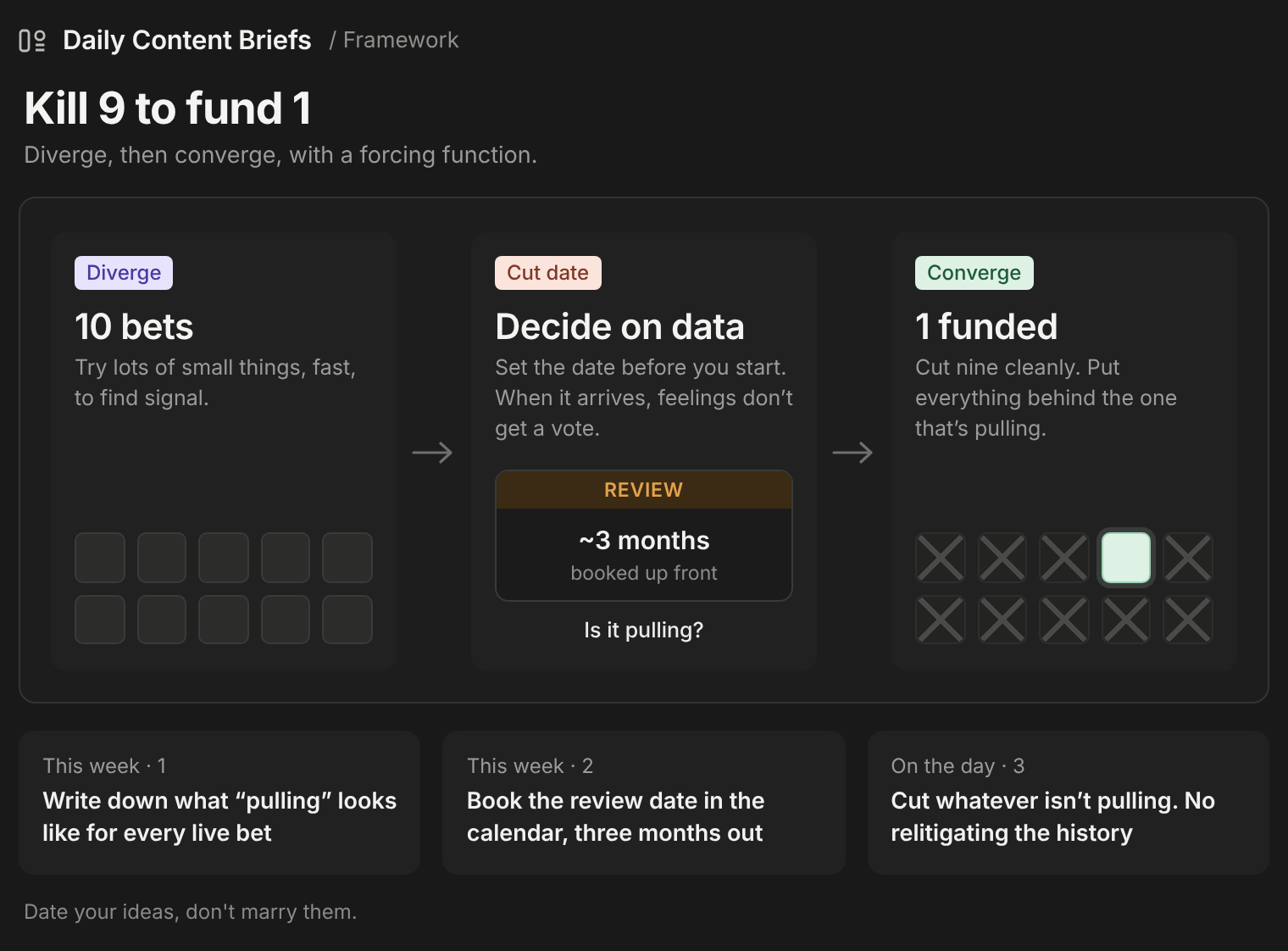
Founders worry about focus the wrong way round. They think the risk is spreading too thin, trying too many things. In my experience mentoring early teams, that's rarely what kills them. What kills them is the opposite: an inability to stop.
The healthy pattern is diverge, then converge. Early on you should try many things: ten quick bets to find signal. The discipline isn't in the trying. It's in the cutting. Try ten, kill nine, and concentrate everything behind the one that's working.
The reason "kill nine" is so hard is that cutting always comes after investment. By the time the evidence says stop, you've already poured in months, money, and identity. So you keep the project breathing and call it perseverance. That's the sunk cost fallacy, and it's one of the most expensive biases in business precisely because it wears the costume of loyalty.
The antidote is a forcing function. Decide the review window in advance (three months is a sensible default) and define what success looks like before you spend a thing. When you hit the date, you assess on data, not comfort. The project is either pulling or it isn't. If it isn't, you cut it, cleanly, without relitigating the history.
This matters more right now. More venture-backed companies have shut down this year than at any point on record, according to Andreessen Horowitz data published in September. Plenty of those closures come down to timing and the cheap-money years. But in the teams I mentor, the failure I see most often is a good founder who couldn't bring themselves to kill a project the data had already condemned. That one is within your control.
Set the review date before you begin. Let the calendar make the decision your ego won't. Or, as I tell every founder I mentor: date your ideas, don't marry them.