
Own your focus, not your infrastructure
Building in-house can feel free when the skill is already in the room. Here is a simple way to weigh build against buy, and why the ongoing cost is often the part people miss.

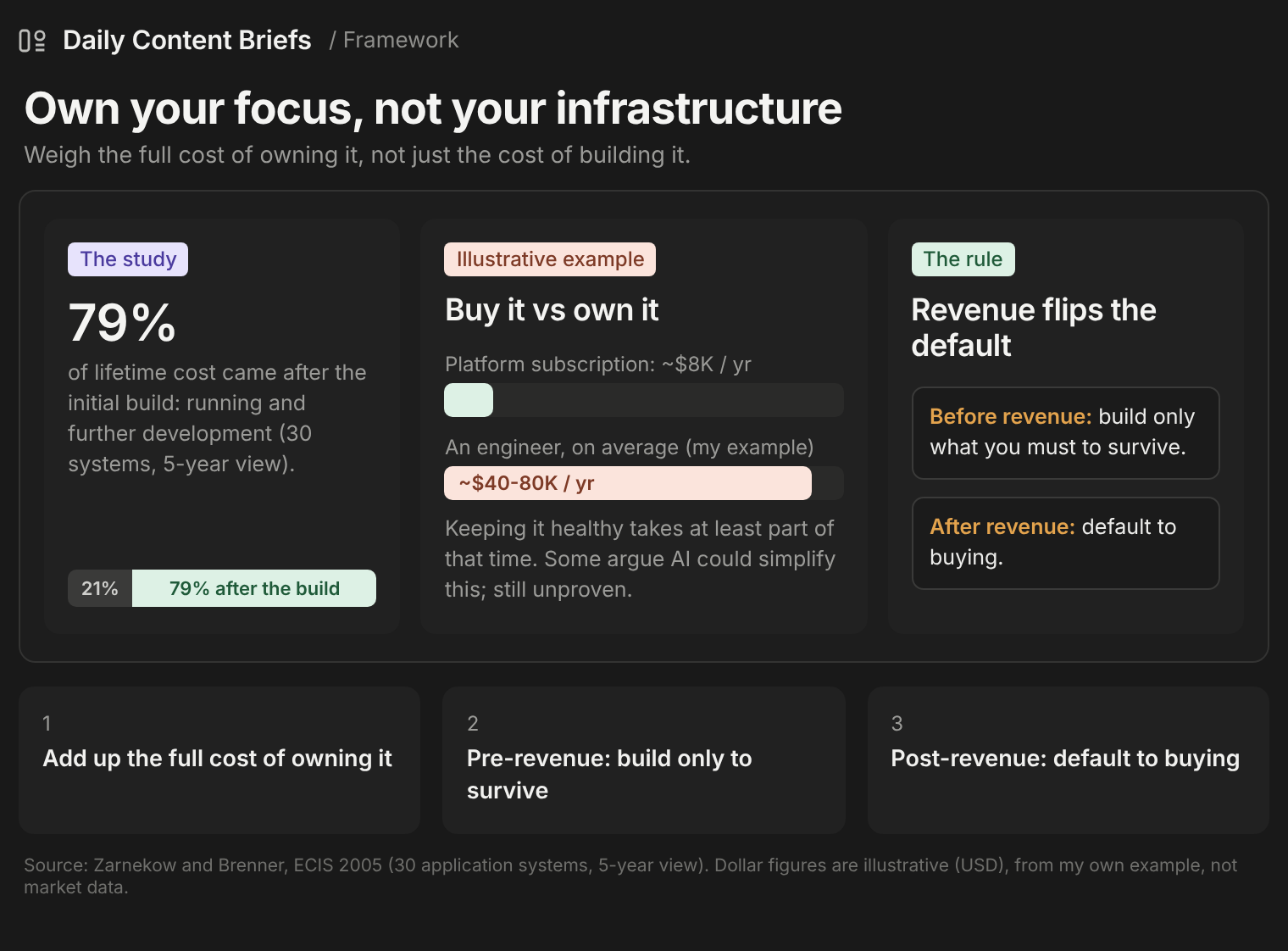
"Why pay $8K a year for a platform when we can build it in-house?" It's one of the most natural questions in an early company, and I hear versions of it from the founders I mentor. It can be a good question. It's often asked with only half the numbers on the table.
Here's the other half. Say the platform costs about $8K a year. Keeping an in-house version healthy takes at least part of one engineer's time: patching, upgrading, fixing what breaks. In my example, an engineer averages roughly $40-80K a year. Your own figures will differ, and some argue AI could simplify this kind of work, though that's still unproven. Even a part-time slice of that time has a price, and that's before you count the product work the engineer could have done instead.
None of this is new. A study of 30 business application systems by researchers at the University of St. Gallen found that, over a five-year production period, about 79% of lifecycle costs were recurring running and further-development costs, and only 21% went on planning and initial development (Zarnekow and Brenner, 2005). Treat any single percentage with care. The authors point out how poor the cost data was, and the spread between systems was wide. But the direction is clear: the build is often the cheaper part, and the bill that keeps arriving afterwards is the one that tends to go missing from the build-or-buy conversation.
In my experience, engineer-founders tend to default to building. The skill is already in the room, so the work feels free. It rarely is, and founder and engineer attention is among the most expensive things an early company has.
I know because I'm one. I'm an engineer by background, and I've been caught out by this more times than I'd like to admit. "I could build that in a weekend" is usually where it starts.
So here's the simple rule I give founders:
- Add up the full cost of owning it: the subscription on one side, and on the other the people to keep an in-house version alive plus what they'd otherwise ship.
- Before revenue, build only what you must to survive. Cash is often scarcer than time.
- Once revenue arrives, default to buying. Attention usually becomes the scarcer resource.
Outsource what you can afford, and own your focus, not your infrastructure.
A quick audit: list everything your team maintains that your customers don't pay for. Each item may be a subscription you're already paying, in people's time.
Shameless plug 🙂
Webhook infrastructure is exactly the sort of thing teams build themselves and then maintain, so we built a webhooks platform called SolidHooks, so you don't have to.
Launch is for first production traffic: $29 a month, or $348 a year. Scale is for company-wide ingest: $375 a month, or $4,500 a year. You can sign up at solidhooks.com.